






Ten outstanding researchers affiliated with leading academic and research institutions around the world have been awarded funding in the pilot call of the TOP200 NAWA programme.
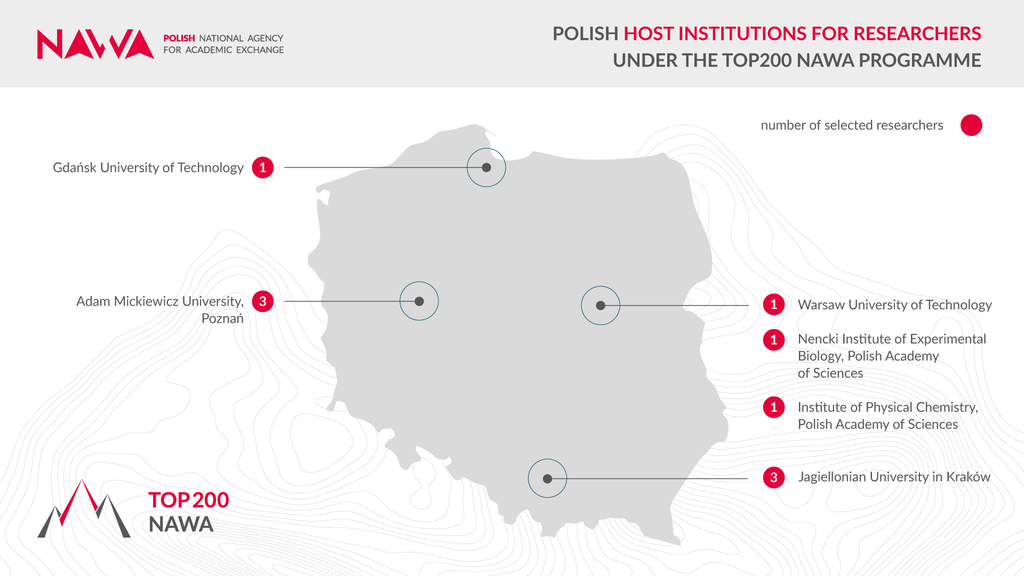
The awardees will carry out their projects at six Polish universities and research institutes.

The TOP200 NAWA programme is an initiative of the Polish National Agency for Academic Exchange. It aims to attract outstanding research talent to Poland from universities ranked among the world’s top 200 in the Academic Ranking of World Universities, QS World University Rankings or Times Higher Education World University Rankings.
The TOP200 NAWA programme is part of the European Commission’s Choose Europe for Science initiative, which promotes researcher mobility and the attraction of outstanding research talent.
With NAWA funding, the researchers will be employed by Polish institutions under stable conditions, enabling them to conduct research and establish their own project teams.
Projects will be implemented under two tracks: Junior Fellow, intended for early-career researchers, and Senior Fellow, aimed at experienced researchers who have led research teams abroad or served as principal investigators on research grants.
Given the high quality of the applications submitted, the call budget was increased from the initially planned PLN 17 million to PLN 18,831,800.

“The results of the TOP200 pilot show that Poland can successfully compete for outstanding researchers and that Polish universities are credible partners for researchers from the world’s leading institutions.
From the outset, we assumed that the success of this initiative would be measured primarily by the quality of the applications rather than their number. The TOP200 awardees will share their expertise, build research teams, develop international cooperation and strengthen the position of Polish research.
This is an investment whose impact we will continue to see for years to come,” says Wojciech Karczewski, PhD, Director of NAWA.
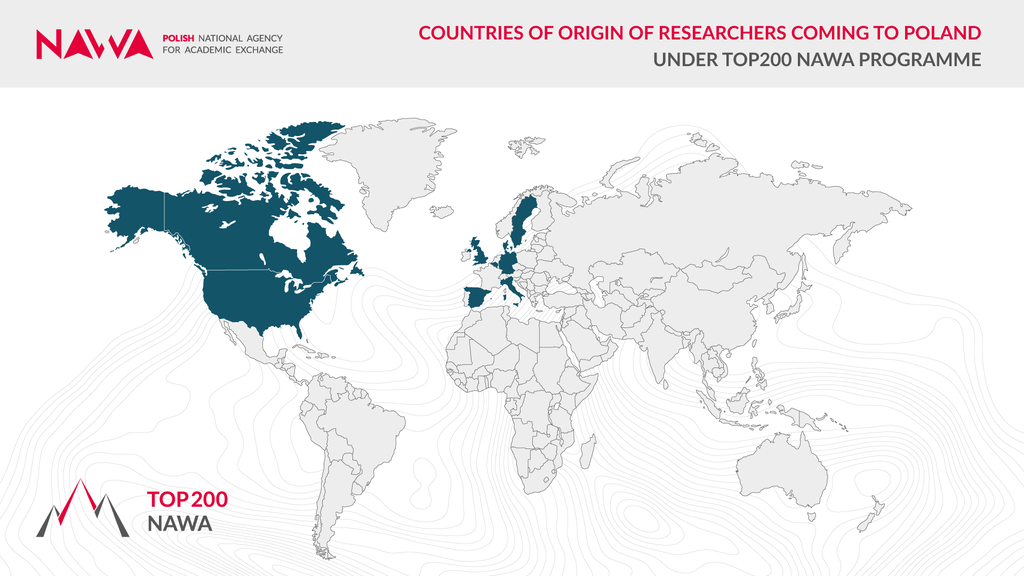
TOP200 NAWA awardees
- Aviezer Tucker – Senior Fellow
Host institution: Adam Mickiewicz University, Poznań
TOP200 institution: Harvard University - Kai Ling Liang – Senior Fellow
Host institution: Nencki Institute of Experimental Biology PAS
TOP200 institution: Ghent University - Xujun Qiu – Junior Fellow
Host institution: Institute of Physical Chemistry, Polish Academy of Sciences
TOP200 institutions: Karlsruhe Institute of Technology and the University of British Columbia - Hernán Felipe Bobadilla Rodríguez – Junior Fellow
Host institution: Jagiellonian University
TOP200 institution: Politecnico di Milano - Magdalena Schacherl – Senior Fellow
Host institution: Jagiellonian University
TOP200 institution: Charité – Universitätsmedizin Berlin - Thomas Andrew Jepps – Senior Fellow
Host institution: Jagiellonian University
TOP200 institution: University of Copenhagen - Anton Chyrkin – Senior Fellow
Host institution: Gdańsk University of Technology
TOP200 institution: Chalmers University of Technology - Adriana Molina-Muñoz – Junior Fellow
Host institution: Adam Mickiewicz University, Poznań
TOP200 institution: University of Oxford - Toni Santana-Ros – Senior Fellow
Host institution: Adam Mickiewicz University, Poznań
TOP200 institution: University of Barcelona - Ahmed Naguib – Senior Fellow
Host institution: Warsaw University of Technology
TOP200 institution: Michigan State University
The full list of applications approved for funding under the TOP200 NAWA Programme (PDF)
The awardees include seven experienced researchers selected under the Senior Fellow track and three researchers selected under the Junior Fellow track. They will carry out projects in Poland across a wide range of disciplines.
The group also includes scholars in the humanities specialising in areas such as history, historiography, the philosophy of history, philosophy and linguistics. The remaining projects cover fields including astronomy, chemistry, materials engineering, cancer research, childhood obesity and the functioning of the human brain.
The presence of researchers affiliated with such renowned institutions as Harvard University, the University of Oxford and Michigan State University will create new opportunities for Polish research teams.
The programme is designed to facilitate knowledge transfer, support the development of international cooperation networks and strengthen Poland’s presence and visibility in the global research community.
The programme is named after Professor Rudolf Weigl, an outstanding Polish biologist, physician and inventor of the world’s first effective vaccine against epidemic typhus.
The TOP200 NAWA programme is a pilot initiative. The outcomes of its first call will be evaluated and will inform the Ministry of Science and Higher Education’s decision on whether the programme should be continued.